


Facts & Figures...
-
The ecosystem of Quissett Harbor and the Knob is made up of a number of interdependent natural resources.
-
According to the Coalition for Buzzards Bay, Quissett Harbor was recently ranked as one of the eight best embayments within the Buzzards Bay watershed for water quality.
-
Tides in southeast Massachusetts are semi-diurnal, with two highs and two lows each day. Tides in Quissett Harbor and around the Knob have a mean range of 4.3 feet.
-
The harbor area and Knob are visited by approximately 12,300 people during a normal year. These visitors include local and summer residents as well many other visitors from around the world.
-
The walking distance from the trailhead to the Knob overlook is under one mile.
-
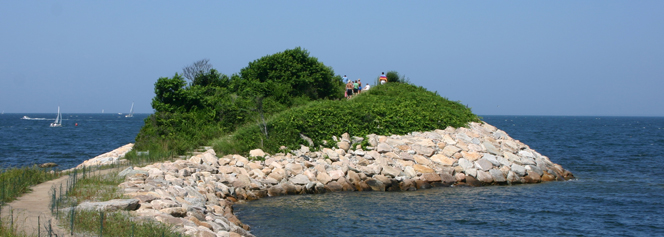
The Knob lot is a 12 acre undeveloped parcel surrounded by Buzzards Bay and Quissett Harbor.
-
The Knob was left to Salt Pond Bird Sanctuaries by Cornelia L. Carey upon her death in 1973.
-
The Knob and the next headland to the south, Gansett Point, form the entrance to Quissett Harbor.
-
The coastal dunes, coastal beaches, and coastal banks provide storm damage protection and flood control for the upland areas.
-
The dunes, beaches and banks protect the salt marsh which nurtures the shellfish and marine fisheries, and provides habitat for many different species of birds and animals.
-
These natural resources provide tangible human benefits such as aesthetics, recreational activities, public use, and flood/pollution control.
-
The entire central portion of the Knob lot is classified as a coastal bank.
-
Sediments within the coastal bank were deposited as a glacial moraine, and are composed of poorly sorted sands, silts, pebbles, cobbles and boulders.
-
Beaches around Quissett Harbor are composed of medium to fine-grained sand with intermittent boulders eroded out of the adjacent coastal bank.
-
The Buzzards Bay beaches on the Knob lot are slightly coarser, ranging from medium to coarse-grained sand with cobbles.
-
The primary coastal dunes are located on the Buzzards Bay side, near the landward edge of the coastal beach.
-
Salt marsh species propagate in areas of relatively low wave energy and occur exclusively on the Quissett Harbor side of the Knob.
-
The largest area of salt marsh is located at the end of the Quissett Harbor footpath, where storm waters are trapped behind a beach ridge, allowing the growth of salt marsh species.
-
A number of vegetation zones have been identified around the harbor and on the Knob lot. They were delineated based on dominant species and plant types within each zone.
-
The vegetation zones include mature oaks, cedars and red cedars along with smaller willow, birch and beech trees. The understory species primarily include shrubs, arrowwood, bittersweet, greenbriar, honeysuckle, blueberry, bayberry, beach plum, privet, sumac, poison ivy, goldenrod, beach grass, dune and high marsh vegetation, salt hay grass, beach rose and salt marsh cordgrass.

